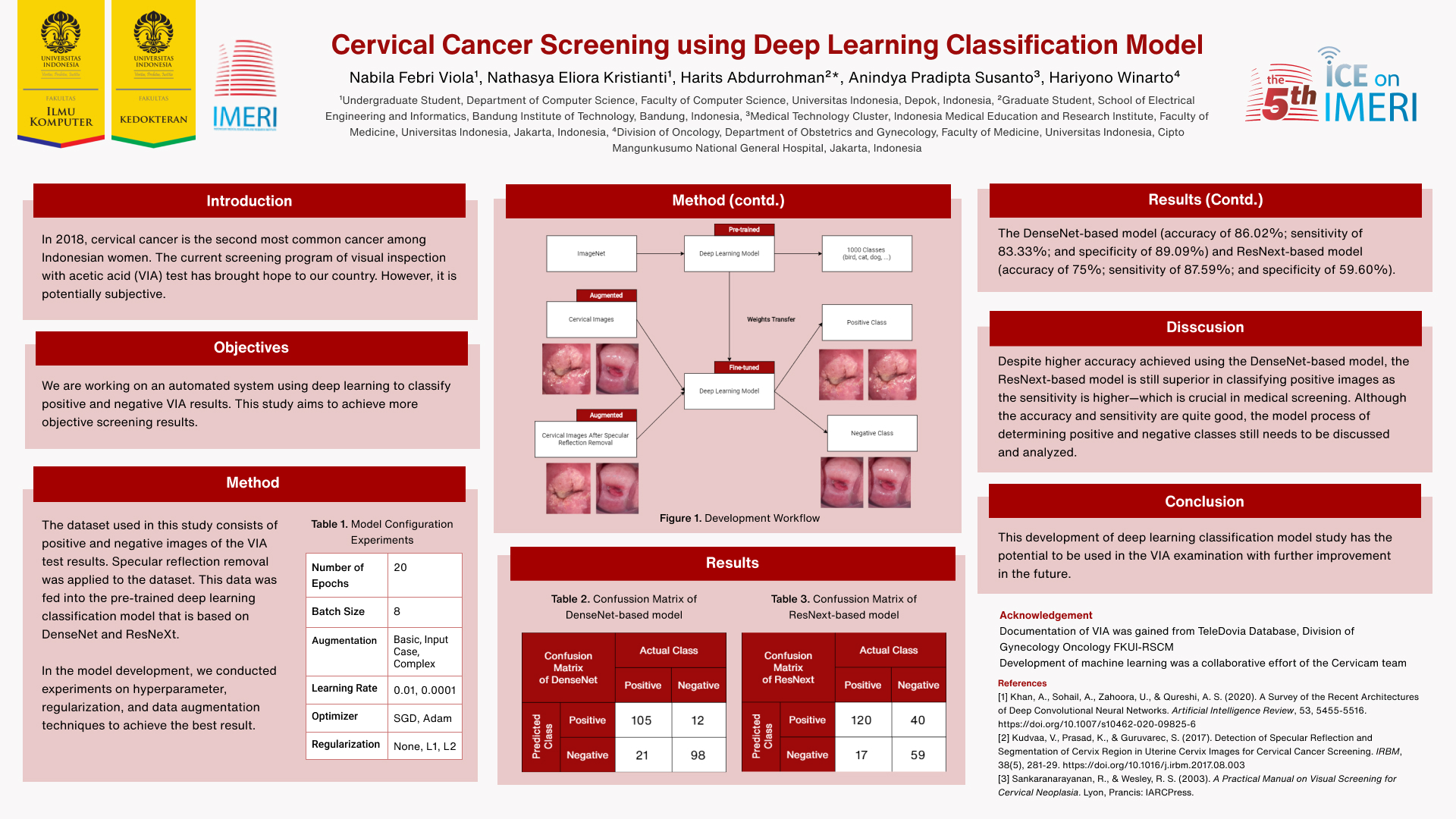
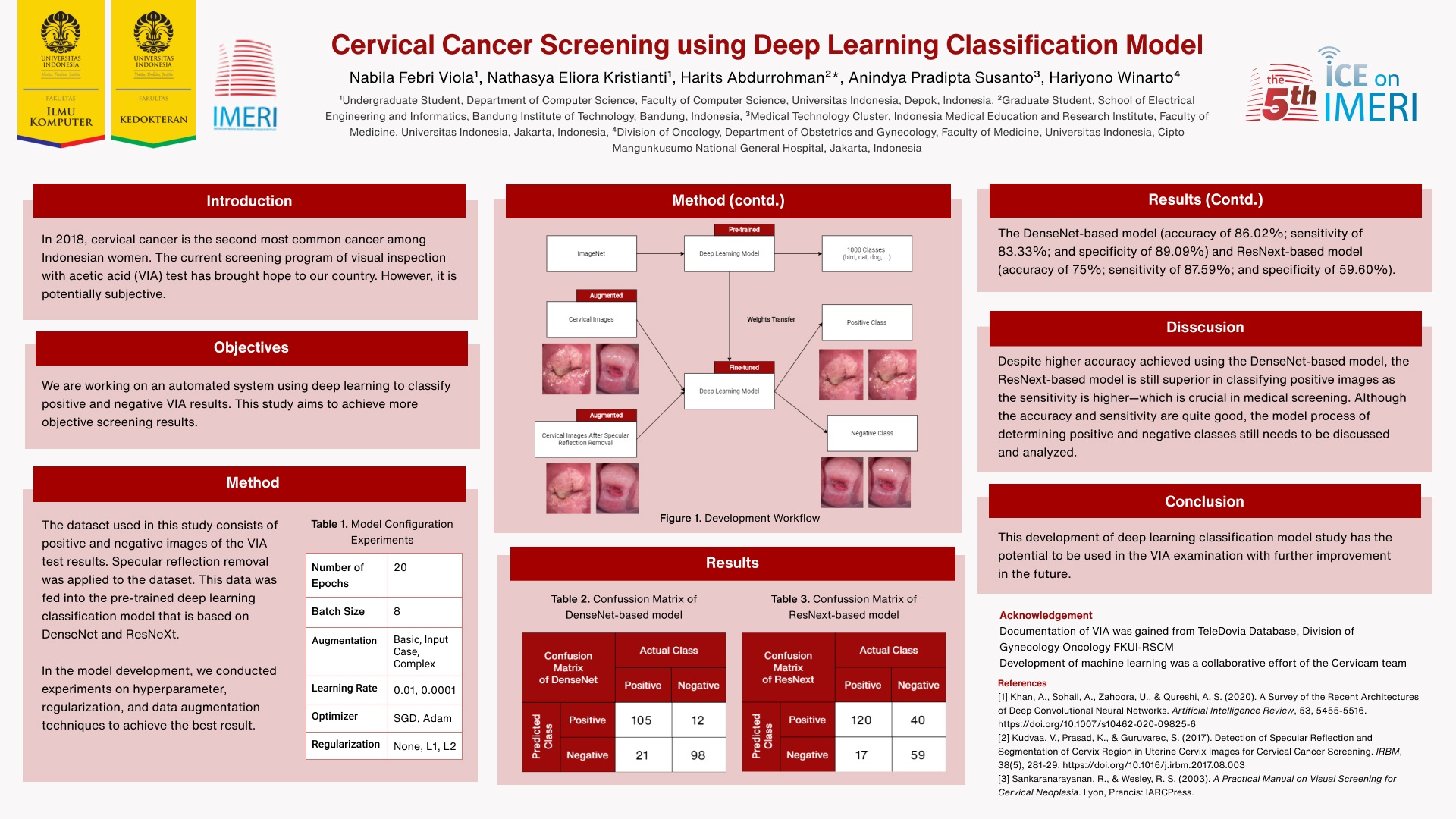
This was a two-person project I’m working on when I was a Machine Learning Engineer intern. In this writing, I am explaining my part of the work. For full picture of the project (abstract poster and presentation) can be seen on this website. The images are confidential, so theres not much to be shown.
Research Points
Specular Reflection Removal
Steps:
Specular Reflection Detection
Masking
Inpainting
Exploration Plan
Choosing Best Pretrained Model
Choosing the Best Configuration
Includes data augmentation plan and hyperparameter tuning (learning rate, optimizer, dropout, regularization, epoch, batch size)
Re-training and Evaluation
Using the best pretrained model and configuration based on previous steps.
ResNext-based Model Experiments
Accuracy 0.75, sensitivity 0.87, and specificity 0.59.
Conclusion & Suggestion
Specular reflection can be used to handle bad data problem.
Image augmentation can be used to help small dataset size problem.
The ResNext model perform good in predicting cancer positive photos (high sensitivity), which is a good thing because this is crucial in medical screening. Still, open for improvement.
The interpretability of the model still has to be discussed and analyzed.
Lesson Learned
Research flow is continuous. Read, brainstorm, experiment, analyze, repeat. Do it all over again.
Communication is crucial. Discuss with team member to overcome issue quicker and present to non-IT stakeholder using simple words as human as possible.
Documentation will save your time and others. Always document every steps of the research and save it nicely, from your literature study, brainstorming notes to research regular report. It’ll help you find things quicker and help other people who will continue your work onboard faster.